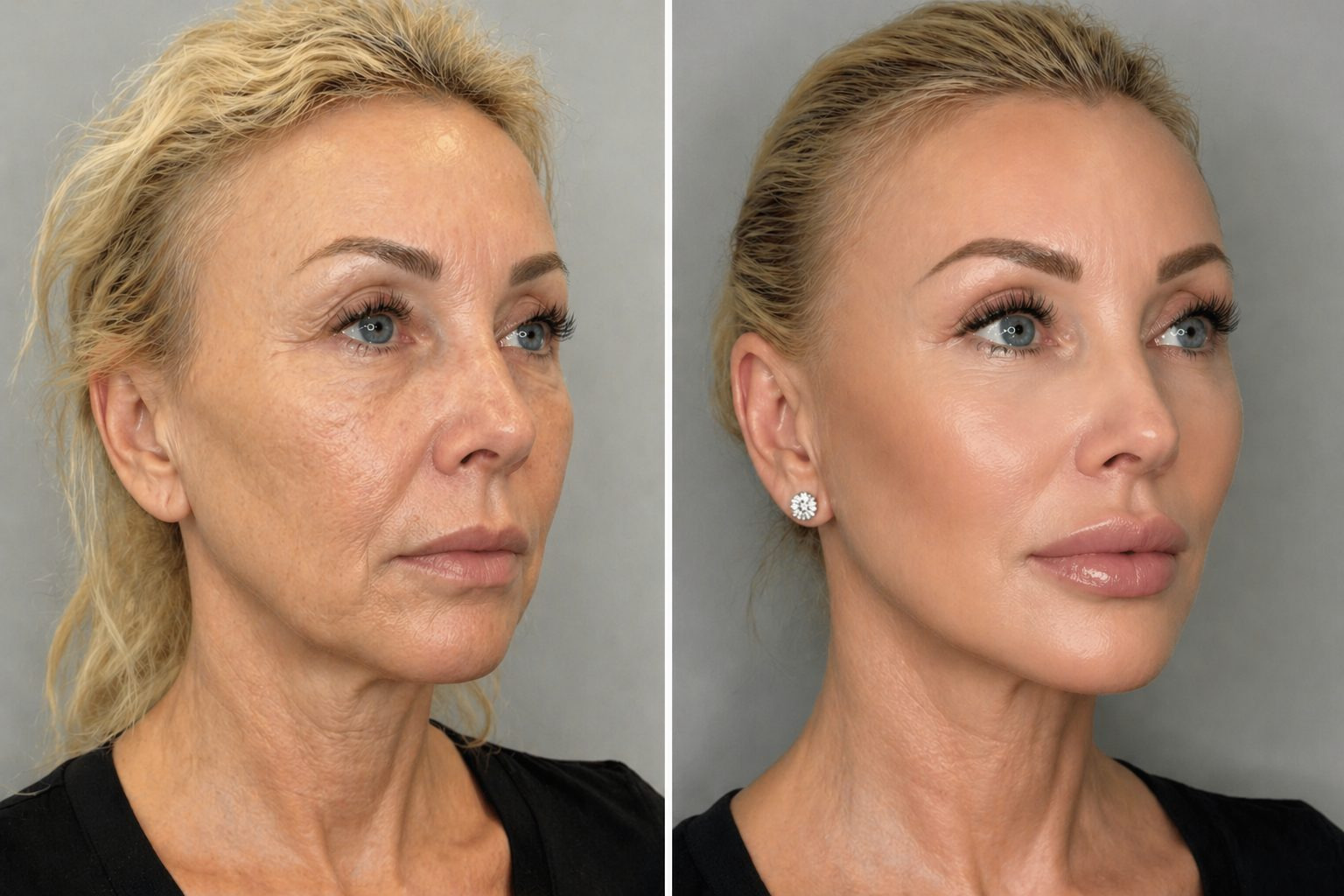
When someone says “I don’t want to look operated,” this is what they mean: surgery should lift the structures that descended, not pull on the skin. That’s why the modern era of facelift works in deep planes.
Quick takeaways
- Facial aging is volumetric and structural: tissues descend, fat pads migrate, bones reabsorb.
- Modern facelift acts on the SMAS (deep muscular layer) or in the deep plane, not the skin.
- Mini-lift works for younger patients with early descent; extended SMAS and deep plane handle established descent.
- Natural results last 10–15 years; the face keeps aging, but from a better starting point.
The big shift: working the SMAS
Thirty years ago, facelifts pulled on skin. It was simple, but it had a problem: skin doesn’t tolerate tension and stretches over time, producing the “wind-blown” look everyone associates with the old facelift. Today the work is on the SMAS (Superficial Musculo-Aponeurotic System), a fibromuscular layer that does hold tension durably. The skin redrapes without stress.
Modern facelift types
Mini-lift (S-lift, MACS-lift)
Short scar limited to temporal and pre-auricular areas. For patients age 40–55 with early descent of the midface. Faster recovery (2 weeks for social life).
Extended SMAS
The “modern classic” facelift. Uses plication or resection of the SMAS to better reposition cheek, jawline and neck. Excellent durability, 3–4 weeks recovery.
Deep plane
Lifts SMAS and skin as one unit, accessing deeper planes where retaining ligaments live. The most demanding technique and, in selected patients, the one with the most natural and lasting result. Requires surgeons with specific training.
The neck — inseparable from a facelift
A facelift without addressing the neck doesn’t actually rejuvenate. Platysmaplasty (correction of platysmal bands) and submental liposuction usually accompany the lift for a balanced result. Some patients need only neck surgery.
“Ideal age” is on your face, not in your IDThe first facelift today averages between 50 and 58, when descent is real and the skin still redrapes well. Operating too early doesn’t pay off; too late, neither.
How surgery is performed
General anesthesia or deep sedation in a licensed facility. Duration: 4–6 hours for extended SMAS or deep plane. Scars run in front of and behind the ear, hidden in the natural hairline. Drains for 24–48 hours, compression bandage.
Realistic recovery
| Period | What to expect |
|---|---|
| Day 1–3 | Bandage, edema, bruising. Rest at home. |
| Week 1 | Suture removal. Marked edema. Stay in. |
| Week 2–3 | Light activity, social outings with concealer. |
| Week 4–6 | Full social life. Light cardio. |
| Month 3 | Face “settles.” Pink scars in maturation. |
| Month 9–12 | Final result. Scars nearly invisible. |
Relevant risks
Hematoma (1–8% by technique), temporary alteration of facial nerve branches (mostly recoverable), hypertrophic scarring, transient alopecia around scars. Major complications are rare with board-certified surgeons and licensed facilities.
What is NOT a facelift
“Thread lifts,” “non-surgical facelifts” and “laser facelifts” are different procedures with subtle, temporary effects. They can complement, but they don’t replace a facelift when descent is structural. Anyone telling you otherwise isn’t being straight.
Pricing and financing
Mini-lift in Bogotá: USD 4,500–7,000. Extended SMAS or deep plane: USD 7,000–12,000. Comparable pricing in Medellín, Cali, Barranquilla and Bucaramanga clinics. Financing in installments is standard.
Frequently asked questions
How many years does a facelift take off?
Between 7 and 12 years of appearance, while preserving your facial identity. The exact figure depends on starting point and technique.
Will I need to repeat it?
Not mandatory. Some patients have a second lift 12–15 years later; others maintain results with non-surgical treatments.
Are scars visible?
Properly placed and with hair covering the post-auricular area, they’re very discreet. At one year, essentially invisible.
What preoperative tests are needed?
CBC, coagulation, metabolic panel, ECG depending on age and anesthesia clearance.
Can I combine it with Botox and fillers?
Yes — they complement each other. The lift repositions; Botox and fillers refine texture and volume.
Natural facelift: lift what descended, don’t stretch
In your consultation we analyze your tissues with standardized photography and explain which technique will deliver the most natural, lasting result.