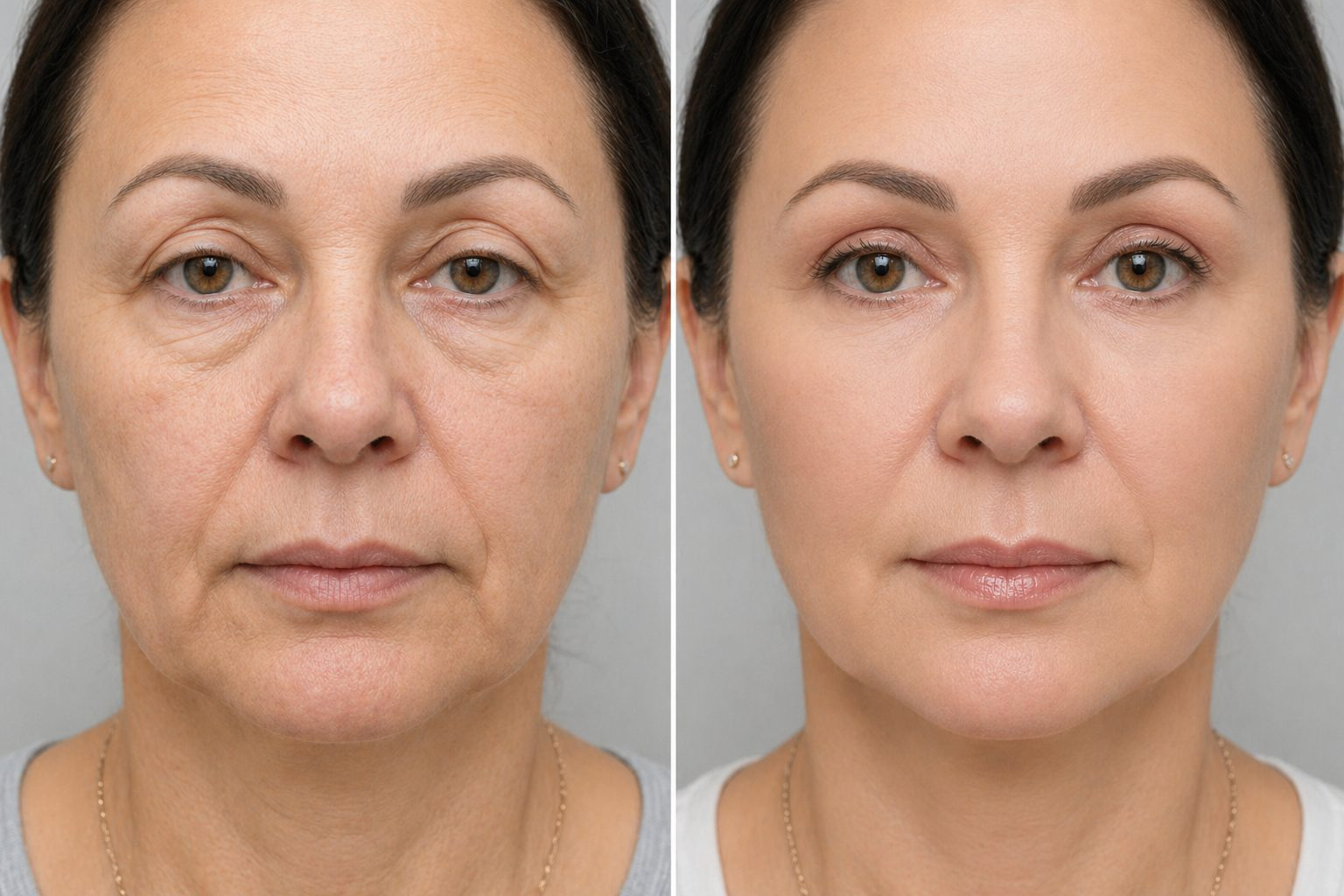
The most common error in blepharoplasty is overcorrection. Removing too much skin from the upper lid opens the eyes artificially; removing too much fat from the lower lid hollows the eye and ages it. Today’s surgery is conservative by principle.
Quick takeaways
- Upper-lid surgery removes excess skin that drapes over the lashes and weighs down the gaze.
- Lower-lid surgery treats fat bags, not aggressive skin removal.
- Transconjunctival technique allows lower-lid surgery without a visible scar.
- Social downtime: 7–10 days. Final result: 2 months.
Upper blepharoplasty
The most frequent indication. With age, upper-eyelid skin becomes redundant, drapes over the lashes and, in advanced cases, narrows peripheral vision. Surgery removes a precise ellipse of skin and, if needed, a small strip of orbicularis muscle. The scar is hidden in the natural lid crease and is essentially invisible at three months.
Lower blepharoplasty
Transconjunctival approach
The incision is inside the lid, no skin mark. It treats fat bags with redistribution or conservative removal. The technique of choice when bags are the only issue.
Subciliary approach
For cases with bags plus excess skin or fine wrinkles. The scar sits just below the lashes and, when done well, is very discreet. Requires preserving lid tone to avoid lowering the lid margin.
Who’s a good candidate?
- Patients with visible upper-lid skin redundancy, especially when it impacts opening.
- Patients with prominent under-eye bags that don’t respond to hydration or non-surgical treatments.
- Patients with reasonable ocular health; severe dry eye must be evaluated carefully — surgery can transiently worsen it.
What blepharoplasty doesn’t fixCrow’s feet around the eyes are caused by the orbicularis muscle and are treated with Botox. Dark under-eye circles from hyperpigmentation are treated with peels or laser. If your concern is color alone, surgery isn’t needed.
How surgery is performed
Local anesthesia with sedation, in a licensed facility. Duration: 60–90 minutes for upper alone, 90–120 minutes for combined upper + lower. Same-day discharge with cold compresses and elevated head positioning.
Realistic recovery
| Period | What to expect |
|---|---|
| Day 1–3 | Moderate swelling, periorbital bruising of variable intensity. |
| Day 5–7 | Suture removal. Swelling drops by ~60%. |
| Day 10 | Presentable appearance with concealer. |
| Month 1 | Pink scar in maturation phase. |
| Month 3 | Scar virtually invisible. Final result. |
Risks worth knowing
Transient dry eye, mild asymmetry, and rarely lower-lid retraction if too much skin was removed. Choosing a surgeon experienced in oculoplastic surgery is decisive.
Pricing and financing
Upper blepharoplasty in Bogotá: USD 1,500–2,800. Lower-lid or combined upper + lower: USD 2,500–4,500. Similar pricing in Medellín, Cali, Barranquilla and Bucaramanga clinics. Financing in installments is common.
Frequently asked questions
Will the surgery change my eye shape?
It shouldn’t. A well-done blepharoplasty preserves the original shape; what changes is the tiredness, not the character of the gaze.
How long do results last?
Upper lid: 10–15 years or more. Lower lid: similar, though skin keeps aging and may need non-surgical maintenance.
Can it be combined with a facelift?
Yes — combinations are routine. If only the eyelids show aging, a facelift isn’t needed.
What preoperative tests are required?
CBC, coagulation, glucose and, in some cases, an ophthalmology evaluation if there are ocular antecedents.
Can I wear contact lenses afterward?
Yes — from day 7–10 depending on swelling.
Rested gaze, not “stretched” look
In your consultation we review eyelid dynamics, brow position and skin quality to define whether surgery is the right step.