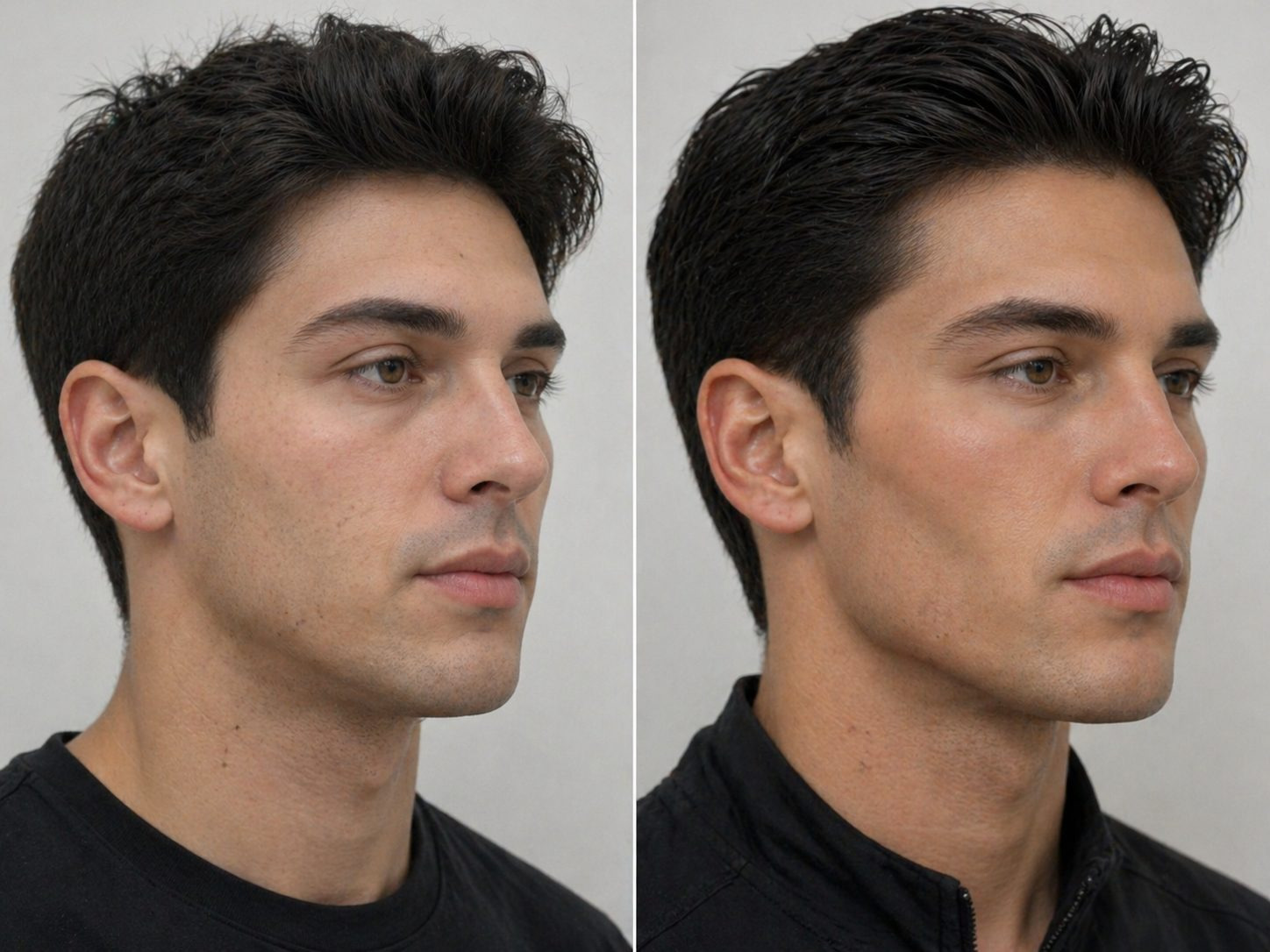
Modern facial planning looks at the side view, not just the front. From profile, two elements define attractiveness: chin projection and cheekbone position. Adjusting one or both changes the global perception of the face.
Quick takeaways
- Three ways to augment chin or cheeks: medical-grade silicone implants, autologous fat grafting and hyaluronic acid fillers.
- Implant = structural and permanent; fat graft = natural but partially reabsorbable; filler = reversible and temporary.
- A recessed chin makes the nose look larger and the neck look saggier; correcting it sometimes avoids rhinoplasty.
- Higher cheekbones open the gaze and visually elevate the entire midface.
Why the chin changes the face so much
When the chin is recessed (microgenia), the line between neck and jaw blurs, nasolabial folds deepen and the nose appears larger than it actually is. Projecting the chin a few millimeters redraws the whole profile. It’s one of the highest-value cosmetic surgeries in visual terms.
Chin implants
Medical-grade silicone implants in different shapes (central, anatomical, with lateral extensions) are placed through an intraoral incision (no visible scar) or submental incision, sitting on the bone. They’re stable, durable and reversible if the result doesn’t satisfy. Surgery: 45–60 minutes.
Cheek augmentation
Implants
Midfacial or malar implants placed via intraoral incision. Structural and permanent results. Reserved for cases with marked hypoplasia.
Autologous fat grafting
Fat is harvested from a donor area (abdomen, flanks), processed and grafted in small parcels onto the cheekbone. 50–70% survives; the rest reabsorbs in the first three months. The most natural option, currently favored by face-focused surgeons.
Hyaluronic acid fillers
For discreet cases, maintenance, or patients not ready for surgery. Immediate visible results, but temporary (12–18 months). An excellent way to “trial” the look before committing to a permanent treatment.
If you’re not sure: try filler firstOne session of hyaluronic acid is a reasonable preview. If you like the result, you can move on to implant or fat graft. If you don’t, the product reabsorbs without trace.
How surgery is planned
Plans use five-view photographic facial analysis, measuring proportions (pogonion, Riedel’s line, nasolabial angle). The surgeon defines how many millimeters to augment, in which vector, and which technique fits.
Realistic recovery
| Procedure | Social downtime | Final result |
|---|---|---|
| Chin implant | 7–10 days | 1 month |
| Cheek implant | 10–14 days | 2 months |
| Facial fat grafting | 10–14 days | 3 months |
| Filler | 1–2 days | Immediate |
Risks worth knowing
Implants: infection (rare, but if it occurs requires removal), displacement, mental nerve sensation alteration (usually temporary). Fat graft: irregularities from non-uniform reabsorption, oil cysts. Fillers: bruising, correctable asymmetry, very rare vascular occlusion with proper technique.
Approximate pricing
Chin implant in Bogotá: USD 2,200–3,500. Cheek implants (pair): USD 2,500–4,500. Facial fat grafting: USD 2,800–4,500. Malar fillers (2 ml): USD 700–1,100. Comparable in Medellín, Cali, Barranquilla and Bucaramanga.
Frequently asked questions
Can the implant be felt to the touch?
Properly placed, no. It sits on bone and under several tissue layers. Only palpable if the pocket was placed too superficial.
Is the scar inside or outside?
Intraoral is preferred — no visible mark. Submental sits in the natural chin crease and is very disguised.
Does fat grafting replace an implant?
For moderate volumes, yes. For substantial structural projection (very recessed chin), implants remain more predictable.
Can it be combined with rhinoplasty?
Frequently. Balancing chin and nose at the same time delivers more harmonious results than treating only one.
Is there a “cat-face” risk?
Only when the cheekbone is over-filled laterally. An experienced surgeon controls projection and preserves natural contour.
Facial balance is invisible when done well
We perform standardized 5-view photographic analysis and digital simulation before proposing any procedure.