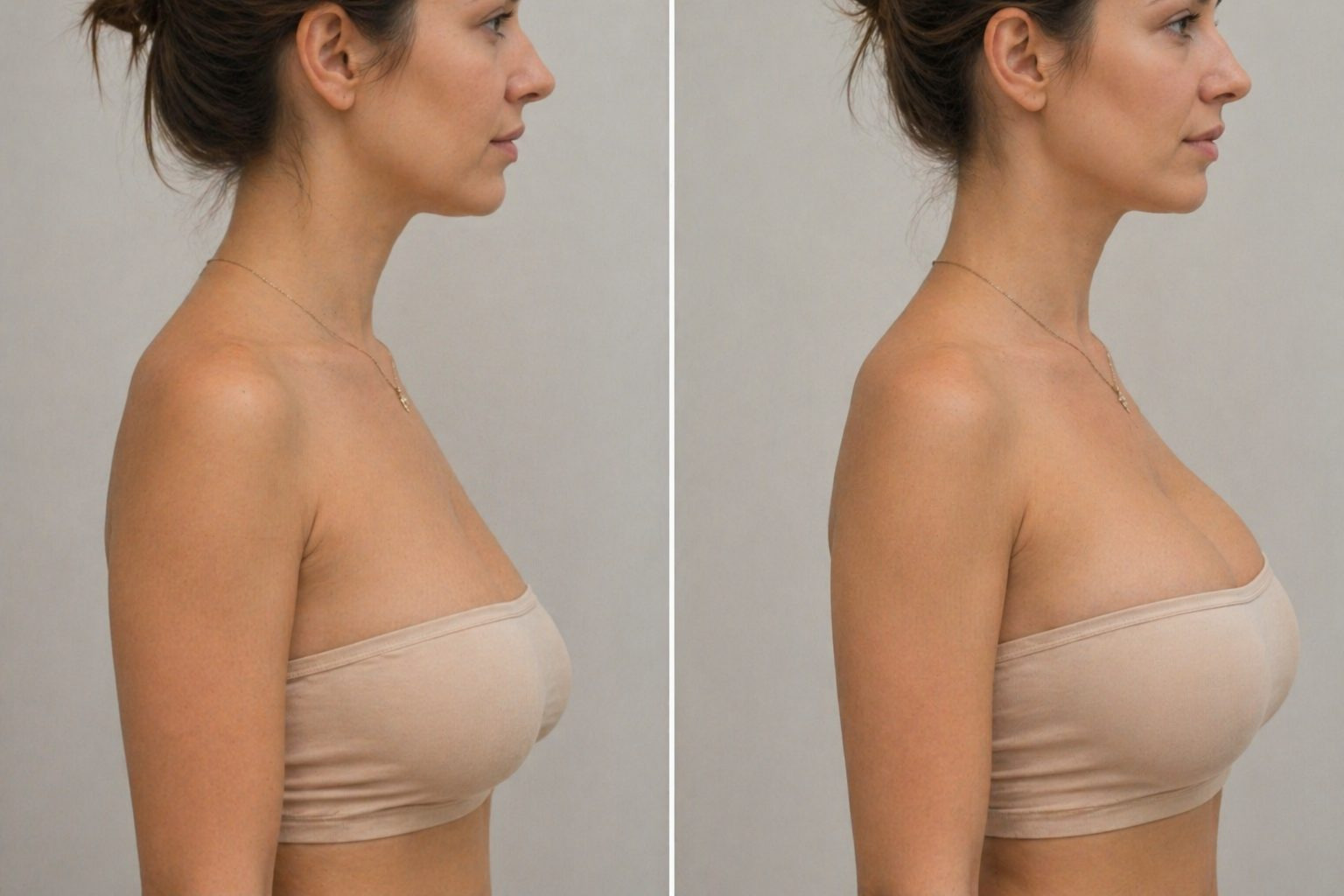
The first mistake when asking for a “breast lift with augmentation” is assuming an implant is always needed. Most ptotic breasts have enough volume; what’s missing is position.
Quick takeaways
- Ptosis is graded by the nipple’s position relative to the inframammary fold.
- A breast lift removes excess skin and repositions the nipple-areola complex. With good volume, no implant is needed.
- If the breast is deflated (atrophy), an implant is added to restore upper-pole fullness.
- The scar pattern depends on the ptosis grade: periareolar, vertical or inverted-T.
Ptosis grades
- Grade I: nipple at the level of the fold. Mild.
- Grade II: nipple below the fold but above the lower pole. Moderate.
- Grade III: nipple points to the floor. Severe.
- Pseudoptosis: the nipple sits well but the gland falls below the fold. Common after breastfeeding.
Each grade has a recommended technique. A well-planned lift uses the smallest scar necessary to correct the actual grade.
Techniques by scar pattern
Periareolar (Benelli, “round-block”)
Scar only around the areola. Indicated for grade I ptosis and pseudoptosis. Also reduces areolar size. Subtle but enough changes in selected cases.
Vertical (Lollipop)
Scar around the areola plus vertical down to the fold. Today’s most versatile technique: handles moderate grade II–III ptosis with good repositioning and no horizontal “T.”
Inverted-T (Wise pattern)
Periareolar + vertical + horizontal at the fold. Reserved for severe ptosis or large reductions with major skin excess. The horizontal scar hides under the breast.
About the scarEvery breast lift leaves a scar. The difference between techniques is how much, not whether there is one. Looking for someone who promises “scarless” is asking for trouble.
Mastopexy with or without implant
Without implant
If you have good native volume and only need positioning, a lift alone is the best option. Natural result, simpler recovery, no prosthetic device to monitor for life.
With implant (mastopexy + augmentation)
Indicated when there’s breast atrophy (deflated breast after breastfeeding or weight loss) and the patient wants upper-pole volume back. More complex because it combines two procedures and requires balancing skin tension with implant weight.
How it’s planned
Planning uses measurements (sternum-to-nipple, fold-to-nipple, breast base), frontal and lateral photos, and — if relevant — implant evaluation. The area to be tightened is marked, and the amount of skin to remove is calculated.
Realistic recovery
| Period | What to expect |
|---|---|
| Day 1–3 | Post-surgical bra, moderate pain, no lifting. |
| Week 1–2 | Home recovery, progressive return to daily life. |
| Week 3 | Return to office work. |
| Month 1–2 | Light cardio. |
| Month 3 | Breast “settles” and lower pole rounds out. |
| Month 6–12 | Scars maturing. Laser and silicone treatments improve final appearance. |
Risks worth knowing
Hypertrophic scarring (more visible in darker skin types, manageable with follow-up), nipple sensation changes (usually recover), mild asymmetry (breasts are always slightly different — including after surgery). Major complications are rare with board-certified surgeons.
Breastfeeding and breast lift
Most modern techniques preserve the lactiferous ducts by keeping the nipple’s blood-supply pedicle. However, if you’re planning pregnancy soon, waiting is recommended: pregnancy and breastfeeding will reshape the breast again and may require touch-ups.
Pricing and financing
Mastopexy alone in Bogotá: USD 3,200–5,500. Mastopexy with augmentation: USD 4,800–7,800. Comparable pricing in Medellín, Cali, Barranquilla and Bucaramanga clinics. Financing in installments is the norm (6, 12, 18 or 24 months).
Frequently asked questions
How long do results last?
10–15 years or more, with stable weight. Pregnancy or significant weight loss can alter the result.
Are scars very visible?
Pink at first. They lighten by 6–12 months. With proper care (topical silicone, sun protection, laser when applicable) they remain acceptable.
Can I breastfeed afterward?
In most cases yes, especially with modern pedicle-preserving techniques. Your surgeon will assess this.
What preoperative tests are needed?
CBC, coagulation, glucose, breast ultrasound, mammogram by age, anesthesia clearance.
Lift or augmentation alone?
If your nipple is above the fold, probably augmentation. If it’s at or below the fold, mastopexy (with or without implant). Measurement decides — not preference.
The right breast lift respects your existing volume
We measure, evaluate skin quality and project the result before deciding whether you need an implant. No pressure.