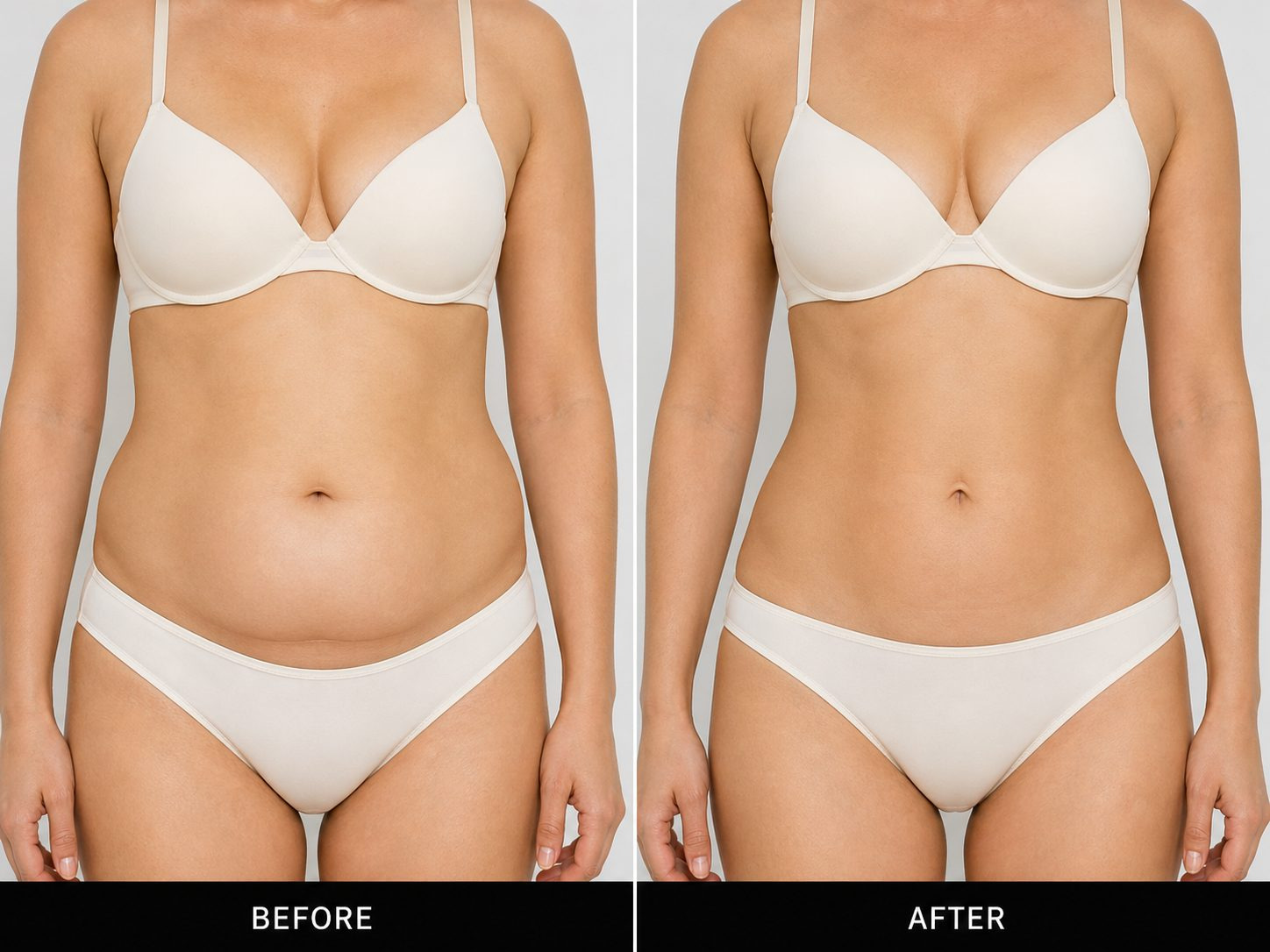
Simple rule: if your abdominal issue is fat alone, liposuction is enough. If there’s excess skin or muscle separation (diastasis), no amount of lipo will solve it — abdominoplasty is the answer.
Quick takeaways
- A tummy tuck removes excess skin and fat and, critically, repairs the separation of the rectus muscles (diastasis).
- Three variants exist: mini, full and extended, depending on how much skin must be removed.
- It’s commonly combined with flank liposuction or a BBL in the same operative session (“Mommy Makeover”).
- The scar sits low — concealable under underwear — but it exists; never trust a “scar-free” promise.
Mini, full or extended
Mini abdominoplasty
For limited issues confined to the lower abdomen (below the navel), with little excess skin and a low diastasis. Short scar, similar to an extended C-section. Faster recovery.
Full abdominoplasty
The most common indication after pregnancies or moderate weight loss. Hip-to-hip scar, navel repositioning and full diastasis repair. Dramatic change when there’s significant separation.
Extended (fleur-de-lis or circumferential)
Reserved for major weight loss (post-bariatric) where skin redundancy goes in every direction. The scar is longer, but the functional and aesthetic gain is enormous.
Three honest candidacy questions
- Is my weight stable? Operating before reaching a stable weight is a poor decision — the skin re-stretches.
- Am I planning more pregnancies? If yes, waiting is the right call.
- Do I smoke? Tobacco dramatically increases skin complications. It must stop at least 4 weeks before and 4 weeks after.
About diastasisUp to 30% of women retain some rectus muscle separation after pregnancy. No amount of crunches will close it: surgical repair is the only definitive solution.
How the surgery is performed
Under general anesthesia in a licensed operating room: low incision, skin and panniculus elevation, diastasis repair with permanent suture, removal of excess skin, navel repositioning and layered closure. Often combined with flank lipo for waist definition. Duration: 3–5 hours.
Recovery, week by week
| Period | What to expect |
|---|---|
| Day 1–3 | Semi-flexed posture to protect the scar, drains, moderate pain. |
| Week 1–2 | Progressive walking, drain removal, garment 24/7. |
| Week 3–4 | Upright posture, return to office work. |
| Week 6 | Light cardio (brisk walk, stationary bike). |
| Month 3 | Progressive strength training. |
| Month 6–12 | Scar maturation; final result visible at the one-year mark. |
Risks worth knowing
The most common are seromas, sensation changes in the flap skin (usually recover) and hypertrophic scarring. Major complications — thromboembolism, skin necrosis, deep infection — are rare in licensed facilities with proper prophylaxis.
Pricing and financing
A full abdominoplasty with flank lipo in Bogotá runs USD 4,000–6,500. Clinics in Medellín, Cali, Barranquilla and Bucaramanga work in comparable ranges. Financing in installments is standard through partner lenders.
Frequently asked questions
Will the scar be very visible?
It sits low, hidden under underwear. Its appearance depends on genetics and aftercare; with laser and silicone treatments it improves significantly by year one.
Will I lose weight from the surgery?
Roughly 1–4 kg of skin and fat are removed, but the operation isn’t for weight loss — it’s for rebuilding the contour.
What supplements should I take before?
Vitamin C, iron if anemic, sufficient protein. Stop vitamin E, high-dose omega-3 and herbal supplements two weeks before to reduce bleeding risk.
Is it covered by insurance?
Only in reconstructive cases (post-bariatric ventral hernias, functional sequelae). Cosmetic abdominoplasty isn’t covered.
Can it be combined with a BBL?
Yes — a frequent combination, provided the operating room and team can manage total operative time with anesthesia safety in mind.
Lipo or tummy tuck? Your skin and rectus decide
In your consultation we measure your diastasis, evaluate skin quality, and tell you which procedure will deliver the result you want.