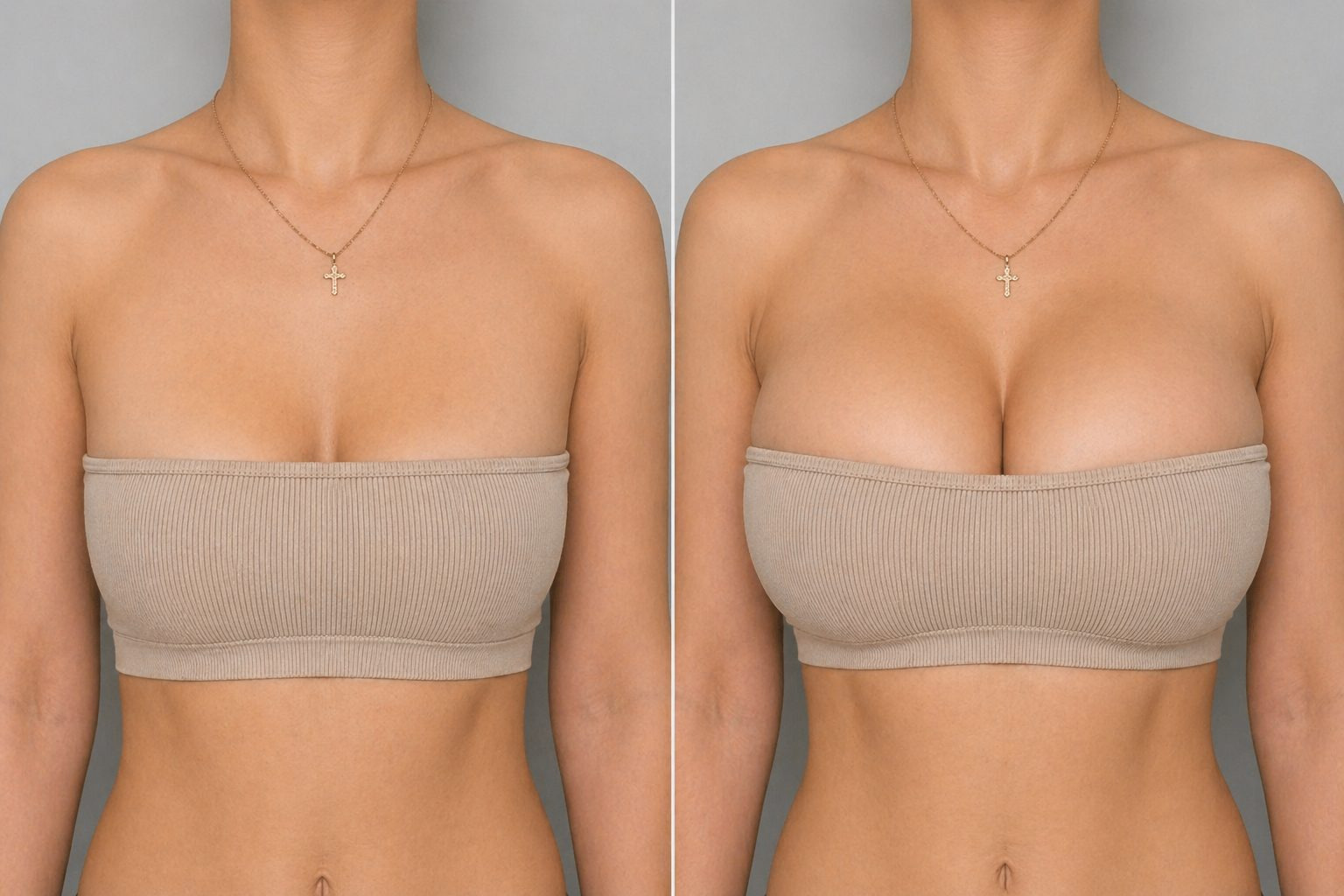
Breast augmentation has been evolving for fifty years and, contrary to popular opinion, today it’s based more on measurements than on preference. The breast base, skin quality and desired projection are measured before anyone discusses cup size.
Quick takeaways
- There are two basic implant shapes: round and anatomical. Each has scenarios where it’s the right tool.
- Implant plane (subglandular, dual plane, submuscular) affects look, capsular contracture risk and sensation.
- Modern implants have an estimated lifespan of 10–15 years; replacement isn’t mandatory without symptoms, but follow-up is.
- The most common incision in Colombia is inframammary, for safety and predictability.
Round implant
The world’s most-used shape. It distributes volume evenly above and below the nipple, lifts the cleavage area, and — being symmetrical — has no risk of visible rotation. Modern textures (smooth or microtextured) have an excellent safety profile. A solid choice for patients with adequate breast tissue who want visible upper-pole projection.
Anatomical (teardrop) implant
More volume in the lower pole and less in the upper, mimicking the natural shape of a breast at rest. Ideal when there’s thin tissue coverage or when the patient wants a discreet result. Its weakness: if it rotates inside the pocket, the deformity is visible. That’s why it requires a surgeon experienced in creating a precise pocket.
What’s trending in 2024–2026The aesthetic shift toward natural results has boosted the popularity of anatomical implants — though moderate-profile rounds still dominate in patients with good native tissue.
Implant plane
Subglandular
Above the muscle, below the gland. More comfortable recovery, better immediate projection, but requires good skin coverage to prevent visible edges, and shows higher long-term rates of capsular contracture.
Submuscular or dual plane
Partially under the pectoralis major. The most-used plane today: it conceals edges, lowers contracture rates and looks more natural in lean patients. Recovery is somewhat more demanding the first weeks.
How size is actually chosen
The cc number isn’t what matters most — what matters is the relationship between the breast base and the implant base. If the implant exceeds the breast base, edges become visible. If it’s narrower, the result looks deflated on the sides. Proper sizing uses calipers, calibrated frontal photos and 3D simulators when available.
Realistic recovery
| Period | What to expect |
|---|---|
| Day 1–3 | Moderate pain, pressure sensation, post-surgical bra at all times. |
| Week 1 | Active rest at home, no lifting more than 2 kg. |
| Week 2–3 | Return to office work, automatic-transmission driving. |
| Week 4–6 | Light cardio, no chest exercises. |
| Month 3 | Full exercise; implant settles into final shape. |
Risks worth knowing
The most relevant: capsular contracture (3–7% at 10 years with modern technique), seroma, sensation changes and, rarely, rupture. The BIA-ALCL discussion (an implant-associated lymphoma) led to stricter surveillance of macro-textured implants; smooth and microtextured implants in current use carry extremely low risk. Your surgeon should explain the exact model and give you the implant card.
Pricing and financing
A primary breast augmentation in Bogotá is typically USD 2,800–4,500, depending on implant brand (Mentor, Motiva, Polytech, Allergan), plane and complexity. Medellín, Cali, Barranquilla and Bucaramanga work in similar ranges. Most centers offer financing through partnered lenders.
Frequently asked questions
Do implants affect breastfeeding?
Generally no. The inframammary incision preserves the ducts. The areolar approach can affect them. Your surgeon will review this in the consultation.
How often must implants be replaced?
There’s no obligation to replace if asymptomatic. Annual ultrasound from year three and an MRI every 5 years are recommended to detect silent rupture.
What preoperative tests are required?
CBC, coagulation, glucose, breast ultrasound and, age-dependent, mammogram. Plus anesthesia clearance.
When does the final result appear?
Settling takes 3 months. Definitive shape, up to 6 months — especially in submuscular plane.
Can I work my chest after?
Yes. Chest exercise resumes around week 8–10 progressively. Some patients prefer to avoid heavy chest training long-term for aesthetic reasons.
The right implant is measured, not chosen by feel
In your consultation we measure your breast base, simulate two or three options and explain why one fits you better than another.